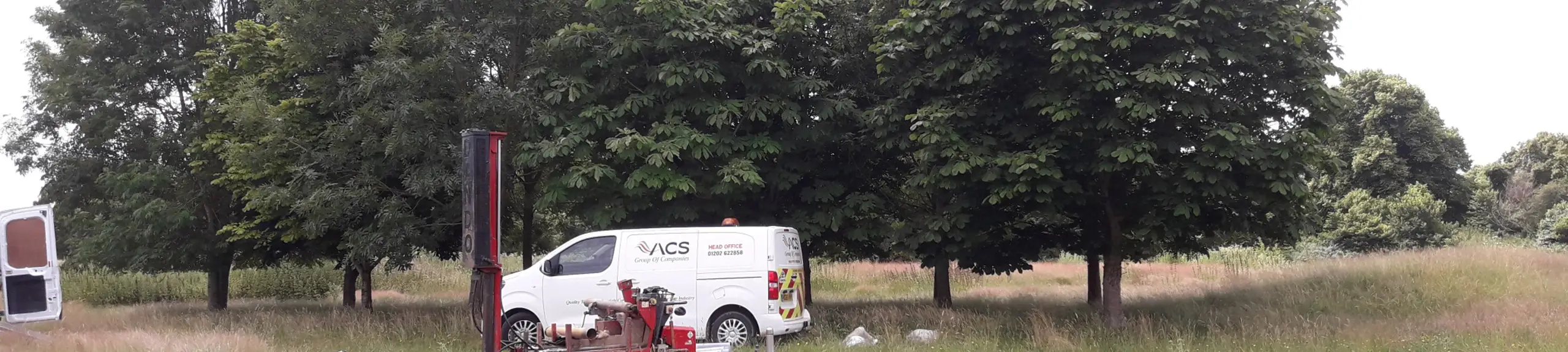
Site investigations are essential for understanding ground and subsurface conditions. They help assess whether a site is suitable for development, identify potential contamination risks, and support safe and compliant design decisions. This information is critical for both construction and environmental projects.
Borehole drilling and coring are among the most commonly used site investigation methods. Two of the most efficient techniques are windowless (window) sampling and cable percussion drilling.
Both methods provide reliable, high-quality ground data and can be used across a wide range of sites. They can also be tailored to meet specific investigation or development requirements.
This article explains how each technique works, when to use them, and how they support accurate and informed decision-making.
Key Takeaways
1. Windowless sampling is best suited to shallow investigations (up to 10m) where undisturbed soil samples are required.
2. Cable percussion drilling allows for deeper investigations (beyond 40m) and is commonly used for piled foundation design.
3. Both methods provide reliable geotechnical and environmental data to support safe development decisions.
4. The choice of technique depends on factors such as required depth, site access, ground conditions, and project objectives.
5. Using the correct investigation method early helps reduce risk, control costs, and avoid delays later in the project.
What Is the Purpose of Windowless Sampling & Cable Percussion Drilling?
Windowless sampling and cable percussion drilling are used to collect soil and ground data for geotechnical and environmental investigations.
Windless sampling allows specialists to collect soil samples to:
- Assess soil properties and structure
- Identify contamination
- Support foundation and engineering design
- Understand environmental impacts
This method is typically used to depths of up to 10 metres below ground level.
When investigations require greater depths, cable percussion drilling is often used. This method allows boreholes to be drilled to depths exceeding 40 metres, making it suitable for deeper ground investigations. Cable percussion drilling is also one of the most widely used drilling techniques in the UK.
Both methods generate reliable data that helps engineers and environmental professionals make informed decisions about site safety, development suitability, and remediation requirements.
Understanding Windowless Sampling
Windowless sampling, also known as window sampling, is commonly used for shallow geotechnical and environmental investigations where relatively undisturbed soil samples are required.
How Windowless Sampling Works
The process involves driving a thin-walled, transparent tube – typically made from acrylic or PVC – into the ground using a percussion hammer or direct push technology. The tube sits inside a steel sampler and supports the soil as it is recovered.
Because the tube is semi-transparent, specialists can:
- Visually inspect soil layers
- Identify changes in stratigraphy (soil layering)
- Detect visible signs of contamination
Key Advantages of Windowless Sampling
Windowless sampling offers several important benefits:
- Undisturbed samples, preserving natural soil structure
- Minimal cross-contamination between soil layers
- Accurate identification of soil composition and stratigraphy
- Fast and cost-effective data collection
These qualities make the method particularly valuable when assessing soil conditions for foundation design and early-stage construction planning.
When to Use Windowless Sampling
Windowless sampling is suitable when shallow, high-quality soil data is required. It is commonly used for:
- Environmental site assessments
- Geotechnical site investigations
- Contaminated land remediation schemes
- Groundwater monitoring wells
- Ground gas monitoring wells
- Laboratory testing
- Foundation design
- Land development and due diligence
- Mineral exploration
The method is often chosen because of its small footprint and flexible access. Compact rigs can move easily around a site and reach areas that larger drilling rigs cannot. Its non-disruptive nature also makes it well-suited to sensitive or restricted locations.
Windowless sampling also enables both core and bulk samples to be taken for laboratory analysis. Testing is carried out in line with standards such as BS EN ISO 14688-1 and BS EN ISO 14689-1, ensuring regulatory compliance.
Understanding Cable Percussion Drilling
Cable percussion drilling is typically used for deeper ground investigations and requires more space than windowless sampling.
Site & Equipment Requirements
The cable percussion drilling method requires:
- Access for a 4x4 vehicle to tow the rig (and carry extra equipment)
- A working area of approximately 5m x 5m for safe setup and operation
The drilling equipment includes:
- Augers
- Shells
- Sampling tubes
Each tool is selected based on the ground conditions encountered.
How Cable Percussion Drilling Works
Once the rig is set up, a drilling tool is lowered into the ground. Drilling takes place by repeatedly lifting and dropping a heavy weight. This action breaks up soil or rock, after which the loosened material (cuttings) is removed at the surface.
Key Advantages of Cable Percussion Drilling
Cable percussion drilling offers several benefits:
- High-quality, reliable samples
- Suitability for a wide range of soils and moderately hard rocks
- Ability to sample multiple ground layers
- Faster sampling than some alternative drilling methods
- Cost-effective for projects with budget constraints
The method is robust, proven, and widely used across the construction and environmental sectors.
When to Use Cable Percussion Drilling
Cable percussion drilling is commonly used when deeper or more detailed ground information is required, including for:
- Geotechnical site investigations
- Environmental assessments
- Mineral exploration
- Contaminated land remediation schemes
- Water well installation
- Groundwater monitoring wells
- Ground gas monitoring wells
- Laboratory testing
- Foundation design
- Land development and due diligence
- Geological studies
The data collected supports interpretative reporting, helping specialists advise on foundation design solutions, contamination levels, and required remediation measures.
Cable percussion drilling is particularly effective for piled foundation design, where ground conditions must be understood at depths beyond the limits of windowless sampling.
Our Borehole Drilling Services
ACS has provided testing and materials consultancy services to the construction industry since 1987. We offer a full range of drilling and coring services, including:
- Windowless sampling
- Cable percussion drilling
- Rotary and rotary sonic sampling
- Limited-access cut-down and modular drilling rigs
We operate extensive in-house equipment and work with trusted subcontractors, giving us access to the latest borehole drilling technology. We also provide UKAS-accredited sampling of aggregates, bituminous materials, concrete, soils, and water for monitoring purposes.
Our experience and resources allow us to deliver investigation services across the South of England, Midlands, London, Wales, and the Isle of Wight, in line with British and European Standards. Services are tailored to suit the requirements of each project.
We understand the operational demands of construction projects and offer flexible working hours, including day and night work where appropriate, to help prevent delays and meet critical deadlines.